Can't Call Us Now?
Schedule your consultation by filling out the form below
Root canals are necessary when the pulp inside a tooth becomes infected, often because of extensive tooth decay, deep damage, or injury. When infection reaches this inner layer, it can cause serious pain and may eventually lead to tooth loss if left untreated. Root canal therapy removes the infection, saves the natural tooth, prevents bacteria from spreading, and helps restore the smile to better health.
The procedure is performed under local anesthesia and is generally much more comfortable than many patients expect. During treatment, the infected pulp is removed, the inside of the tooth is cleaned and sealed, and the tooth is often restored with a dental crown for added strength and protection.
Do I Really Need Treatment?
Yes, if the tooth pulp is infected, treatment is necessary. An infected tooth cannot heal on its own and will usually continue to get worse without professional care. Without root canal treatment, pus from the infected tooth can spread to the root tip and eventually reach the jawbone.
This can lead to a dental abscess, which is a pocket of infection that can damage the bone surrounding the tooth. The pressure from an abscess can cause severe pain, swelling, sensitivity, and difficulty chewing. If left untreated, the infection can spread and may become a serious health concern.
Root canal therapy helps stop the infection, relieve discomfort, and preserve your natural tooth whenever possible.
The Procedure
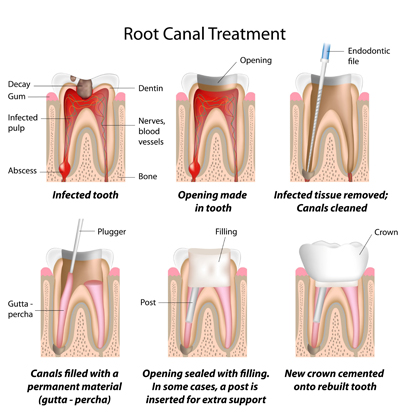
Before the procedure begins, the area is completely numbed using a local anesthetic. Once the area is numbed, a rubber dam is placed around the infected tooth to protect the mouth and to prevent anything from falling into the back of the throat.
In order to access the infected tooth pulp, your doctor for root canals makes an opening through the top of the tooth to get down into the pulp chamber. A tiny instrument, called a dental file, is then carefully used to clean out the infected tissue and to shape the root canals to receive the filling material. X-rays will be taken to ensure that all of the infected pulp is removed before the filling is placed and to confirm that the filling material reaches the ends of the canals in each root.
After the infected pulp is removed, a restoration such as a post and core is placed to reinforce the interior of the tooth. In most cases, a crown is placed to cover, protect and strengthen the tooth. However, if the tooth is severely broken down, it may be necessary to start by building up the tooth with a post and core.
If you have tooth decay that is left untreated, it could necessitate the need for a root canal. Call your doctor for root canals in Richmond, VA to schedule your appointment as soon as possible.